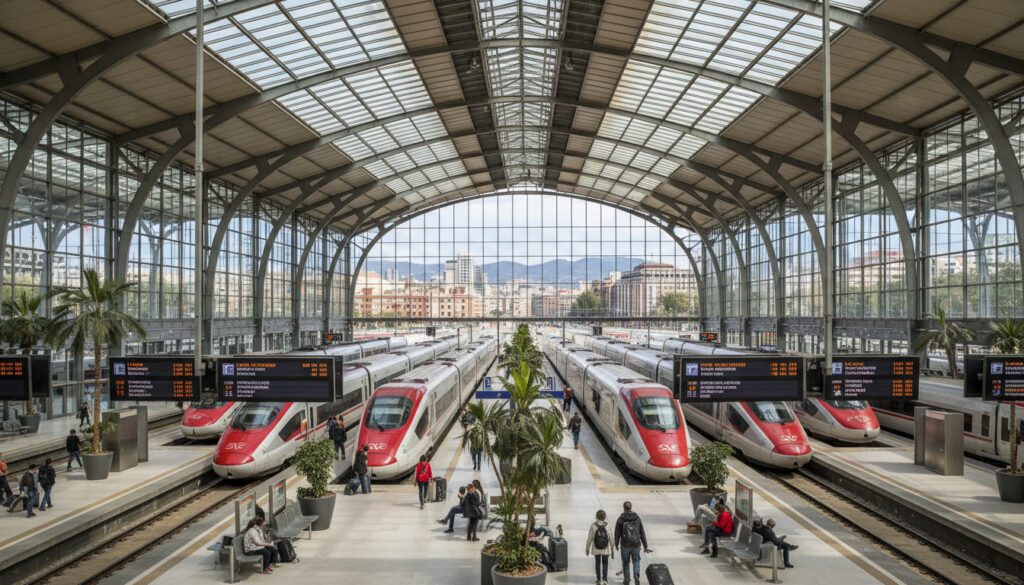
Barcelona Sants Train Station – Guía Esencial para Viajeros
Barcelona Sants functions as the primary railway gateway for Catalonia, processing approximately 30 million travelers annually through its sprawling complex in the Sants-Montjuïc district. Opened in 1975 to replace the city’s outdated terminus stations, this hub integrates Renfe long-distance services with regional commuter networks and metropolitan transit systems.
Infrastructure Overview
- 14 platforms serving national and international routes
- Direct connection to Barcelona Metro lines L3 and L5
- High-speed corridor links to Madrid, with extensions to France since 2013
- Adjacent hotel and commercial complex spanning 100,000 square meters
Operational Dynamics
The station’s design reflects mid-century modernist principles, though recent renovations have introduced expanded accessibility features and digital passenger information systems. Unlike historic terminals such as França, Sants operates as a through-station, allowing continuous rail traffic between the Iberian Peninsula and Central Europe.
Principal Rail Connections
| Destination | Service Type | Journey Time | Frequency |
|---|---|---|---|
| Madrid Puerta de Atocha | AVE High-Speed | 2h 30m | Every 30 minutes |
| Valencia Joaquín Sorolla | AVE/Avlo | 3h 15m | Hourly |
| Paris Gare de Lyon | TGV inOui | 6h 45m | Two daily services |
| Seville Santa Justa | AVE | 5h 30m | Three daily |
Facilities and Architecture
The station complex incorporates three distinct levels: ground-floor regional platforms, underground high-speed tracks, and a comprehensive retail concourse. Travelers access Rodalies de Catalunya commuter services on tracks 1-6, while AVE departures utilize the purpose-built subterranean infrastructure completed in 2008.
The adjoining Sants Estació commercial zone houses hospitality services and maintains direct pedestrian access to the Sants-Montjuïc district municipal facilities. Recent infrastructure investments focus on platform screen doors and improved tactile guidance systems for visually impaired passengers.
Evolution of the Terminal
Construction began in 1971 under Franco-era transportation reforms, with the facility inaugurating in 1975 to consolidate scattered railway operations. The 1990s brought integration with the fledgling Cercanías network, while 2008 marked the completion of tunneling work enabling standard-gauge European rail access.
Current expansion plans include enhanced cycling infrastructure and photovoltaic panel installations across the station’s extensive roof surfaces, targeting carbon-neutral operations by 2030.
Navigational Considerations
Passengers frequently confuse Barcelona Sants with El Prat airport terminals; however, the station lies eight kilometers inland, connected via the Rodalies R2 Nord line. Ticket offices for international journeys occupy a separate annex from domestic Renfe counters, a layout that occasionally generates wayfinding difficulties during peak congestion periods.
Security protocols require luggage screening for AVE services but not for regional trains, creating distinct passenger flows within the main concourse. The facility maintains 24-hour operation, though retail outlets observe standard commercial hours.
Metropolitan Impact
Sants Station anchors one of Barcelona’s primary economic corridors, driving property development in the surrounding Eixample and Sants neighborhoods. The terminal’s cargo facilities, though reduced from their twentieth-century peak, continue processing freight alongside passenger operations. Urban planners regard the station as a model for transit-oriented development, though local residents cite noise pollution from overnight railway maintenance as a persistent concern.
Integration with the Barcelona Metro network ensures the station functions as a multimodal hub, reducing reliance on private vehicles for intercity travel. This connectivity proves crucial during Mobile World Congress and other high-capacity events when conventional road infrastructure faces severe strain.
Industry Perspectives
Barcelona Sants represents the critical southern node of the Mediterranean rail corridor. Its capacity enhancements over the past decade have directly facilitated the 40% increase in Franco-Spanish rail traffic we’ve observed since 2015.
— Elena Vargas, Rail Infrastructure Analyst
The transition from broad to standard gauge here opened the door to true European rail integration, eliminating the bogie-change delays that previously hampered cross-border efficiency.
— Marc Ibáñez, Transport Historian
Strategic Overview
Barcelona Sants maintains its position as the indispensable core of Catalonia’s rail infrastructure, balancing heritage operational requirements with modernization demands. The station’s ongoing technological upgrades and sustainability initiatives position it to accommodate projected passenger growth while maintaining service standards across both domestic and international routes.
Frequently Asked Questions
How do I reach Barcelona Sants from El Prat Airport?
The Renfe Rodalies R2 Nord line connects Terminal 2 directly to the station in approximately 20 minutes. From Terminal 1, travelers must take the free shuttle bus to Terminal 2 before boarding the train. Alternatively, the Aerobús A1 terminates at Plaza Espanya, requiring a short metro connection to Sants.
Are there luggage storage facilities available?
Yes, the station operates 24-hour consigna services located on the ground floor near platform 4. Rates vary by locker size, with oversized storage available for bicycles and sporting equipment. All items undergo security screening before storage authorization.
Which platforms serve high-speed AVE trains?
AVE services utilize the subterranean platforms 10-14, accessible via dedicated escalators and elevators from the main concourse. These tracks feature platform screen doors and distinct signage in both Spanish and Catalan. Regional Rodalies trains depart from surface platforms 1-6.
Can I purchase T-casual transport cards at the station?
Yes, automated vending machines for TMB transport cards are located in the metro station entrance and on the main railway concourse. These machines accept credit cards and cash payments up to €50. The station also hosts a permanent TMB customer service office for card renewals and refunds.
Mas articulos relacionados
 Estadísticas de Ligue 1 2025-26: tabla, goles y récords
 De Dólar a Euro: Tipo de Cambio Actual y Dónde Cambiar
 La sombra de la sospecha: reparto, sinopsis y Netflix
 Permiso 8 Semanas Retribuido – Requisitos y Cómo Solicitarlo
 Ana de Armas y Tom Cruise – Cronología Completa de su Romance
 Vehículo mixto adaptable: qué es y velocidad máxima
 Euros a Pesos Mexicanos: Tipo de Cambio, Conversión y Consejos
 Derivada de una raíz: fórmula, ejemplos y regla de la cadena
